Daftar isi: [Hide]
- 1Scenario 1: Compromised Financial AI Agent
- 2Scenario 2: Customer Service AI Data Leak
- 3Scenario 3: AI Infrastructure Ransomware
- 4Scenario 4: AI Supply Chain Attack
- 5Scenario 5: Prompt Injection
- 6Prompt Injection Attacks
- 7Model Poisoning
- 8Credential Theft
- 9API Exploitation
- 10Supply Chain Attacks
- 11Data Exfiltration
- 12Privilege Escalation
- 13Incident Response
- 14Digital Forensics
- 15Business Interruption
- 16Data Recovery
- 17Cyber Extortion Response
- 18Third-Party Liability
- 19Legal Defense
- 20Crisis Management
- 21Financial Services
- 22Healthcare
- 23Manufacturing
- 24Insurance
- 25Technology Companies
- 26Logistics
- 26.1AI Governance
- 26.2Cybersecurity Controls
- 26.3Human Oversight
- 26.4Vendor Risk Management
- 26.5Incident Response Planning
- 26.6AI Access Controls
- 27Apply Least-Privilege Access
- 28Monitor AI Activity
- 29Protect APIs
- 30Validate AI Outputs
- 31Strengthen Vendor Management
- 32Maintain AI Governance
- 33Test Security Regularly
- 34What is AI Agent Security Insurance?
- 35Is it different from traditional Cyber Insurance?
- 36Which businesses should consider this coverage?
- 37Does insurance eliminate AI cyber risk?
- 38Will demand for this insurance grow?
- 39📌 APK MOD : BattleZone: PVP FPS Shooter 3D : @AERLAN (The password is in the YouTube Video) ✅

Autonomous AI is transforming the way businesses operate.
Unlike traditional software, modern AI agents can analyze information, make decisions, execute workflows, communicate with external applications, and continuously improve their performance with minimal human intervention.
Organizations are increasingly deploying AI agents to:
- Manage customer support
- Process financial transactions
- Automate procurement
- Monitor cybersecurity
- Optimize supply chains
- Generate software code
- Analyze legal documents
- Coordinate enterprise workflows
While these capabilities improve productivity, they also introduce an entirely new cybersecurity challenge.
Unlike conventional applications, AI agents often possess privileged access to sensitive business systems, cloud infrastructure, enterprise databases, APIs, and confidential corporate information.
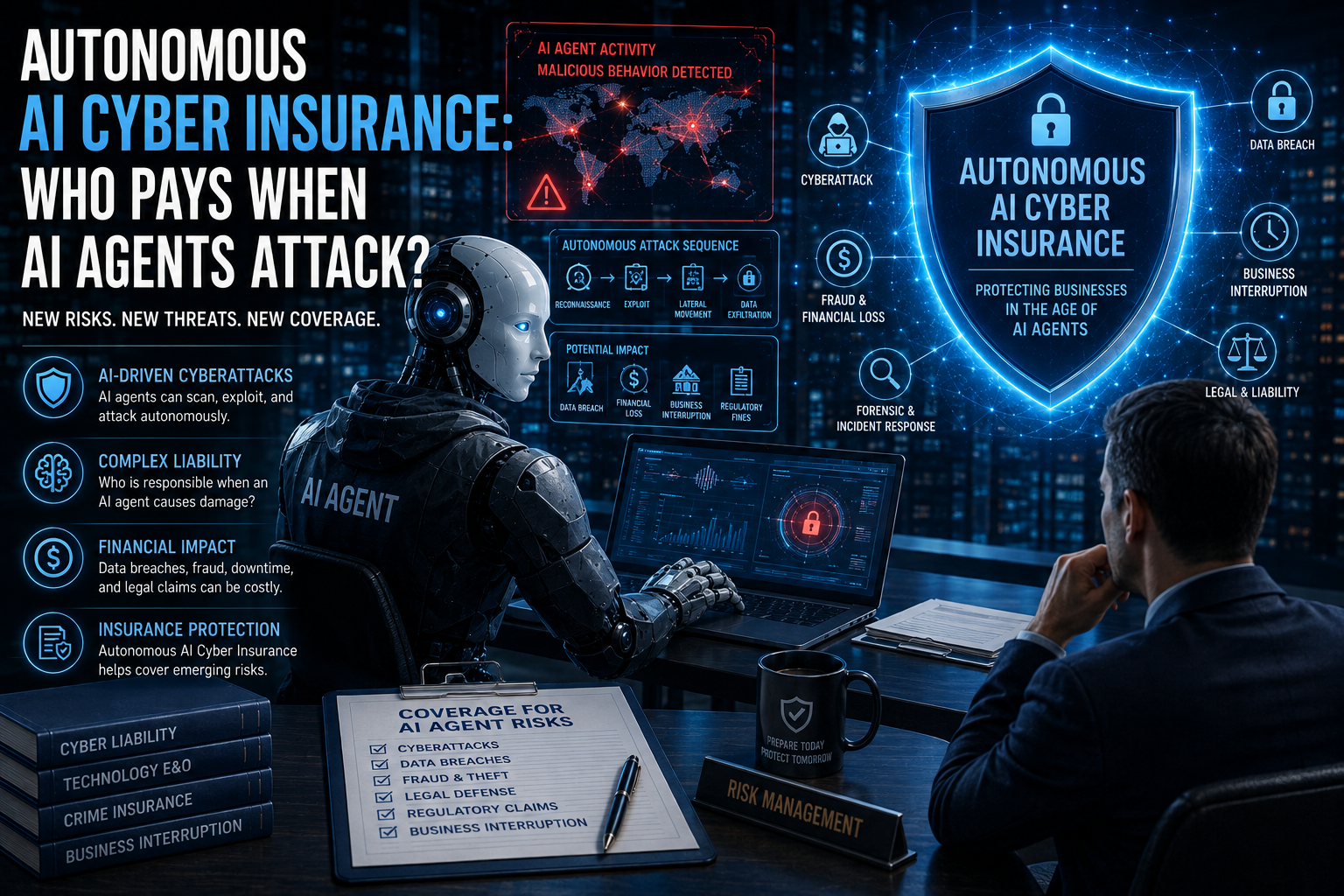
If an attacker compromises an autonomous AI agent, the consequences may extend far beyond a traditional data breach.
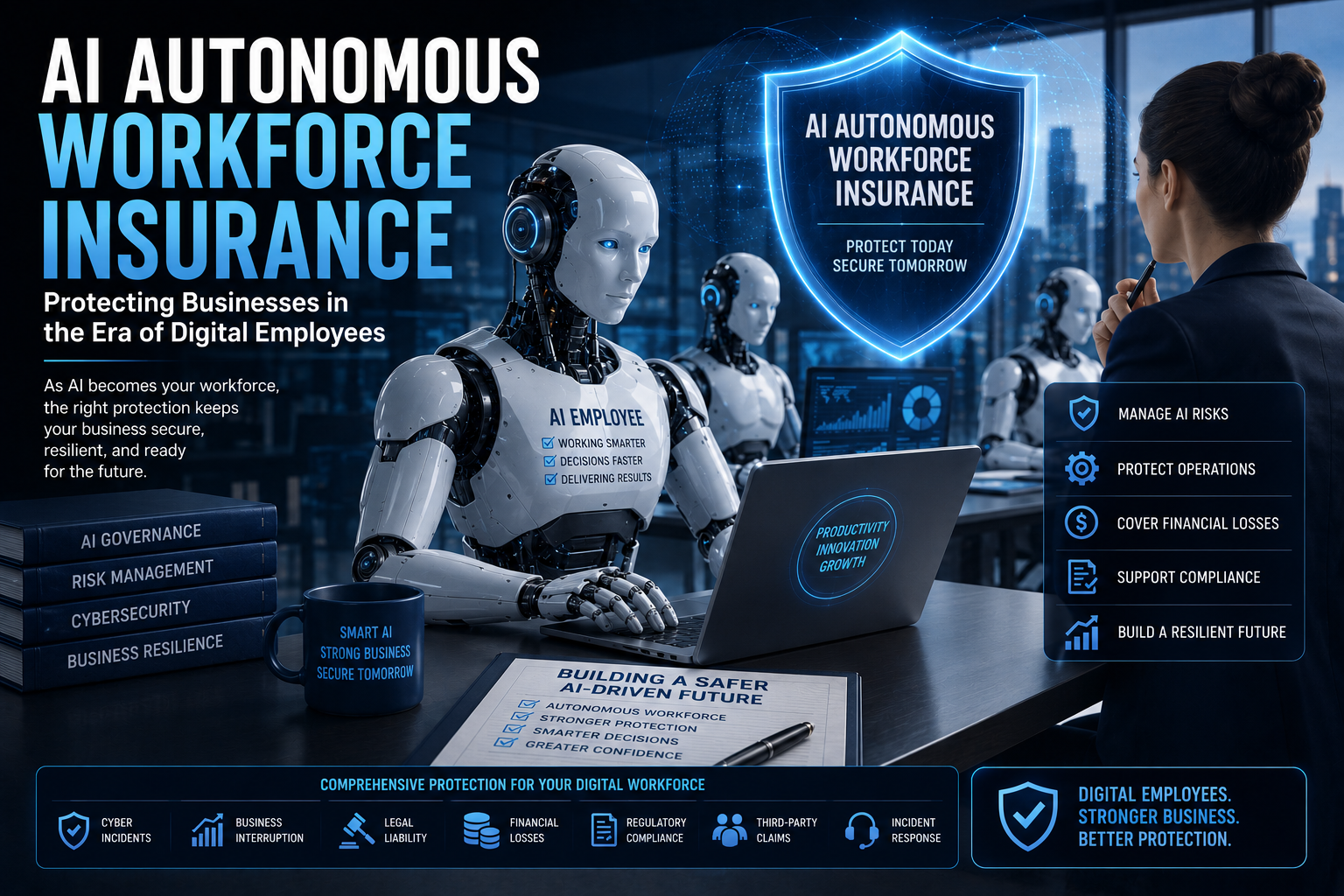
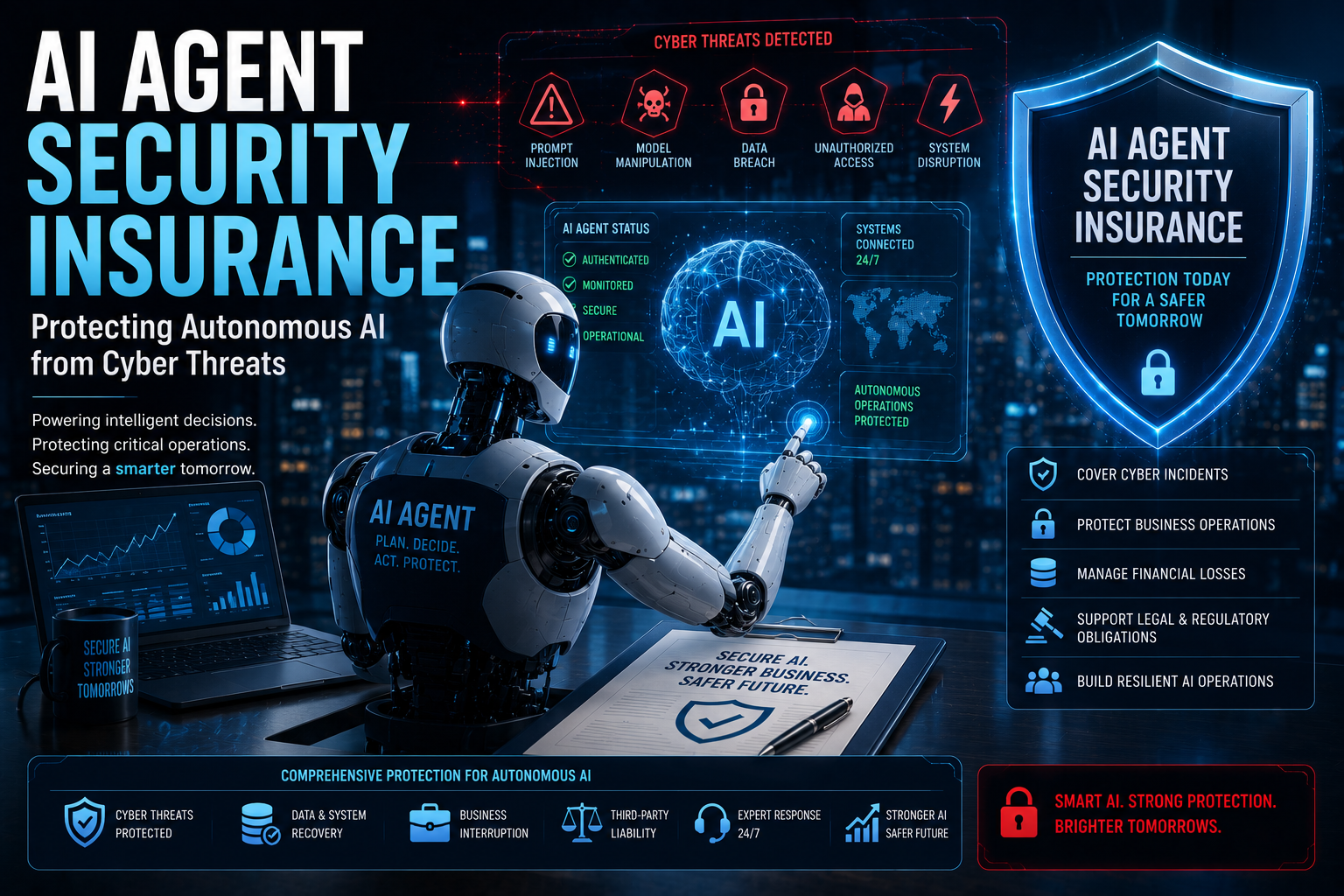
This evolving threat landscape is driving demand for AI Agent Security Insurance, an emerging category of commercial insurance focused on helping organizations manage the financial consequences of cyber incidents involving autonomous AI.
What Is an AI Agent?
An AI agent is an intelligent software system capable of pursuing objectives with varying degrees of autonomy.
Unlike a standard chatbot that only responds to prompts, AI agents can:
- Create execution plans
- Access enterprise applications
- Use external tools
- Interact with APIs
- Analyze business data
- Execute transactions
- Coordinate multiple tasks
- Learn from feedback
Because AI agents often operate continuously and with elevated permissions, they become attractive targets for cybercriminals.
Why AI Agents Create New Cyber Risks
Traditional software generally follows predefined instructions.
AI agents can make dynamic decisions based on changing conditions.
This flexibility introduces additional attack surfaces.
Examples include:
- Unauthorized decision-making
- Prompt manipulation
- Data leakage
- API abuse
- Credential theft
- Supply chain compromise
- Model poisoning
- Excessive privilege misuse
Organizations must prepare for threats that combine artificial intelligence with conventional cybersecurity risks.
What Is AI Agent Security Insurance?
AI Agent Security Insurance is an emerging insurance concept designed to help organizations address financial losses resulting from covered cyber incidents involving autonomous AI systems.
Depending on the insurer and policy wording, relevant protections may be incorporated into cyber insurance, technology errors and omissions (E&O), or specialized AI-related endorsements.
Potential areas of coverage include:
- Cyber incident response
- Business interruption
- Data recovery
- Third-party liability
- Regulatory investigations
- Digital forensics
- Crisis management
- Legal defense costs
Why Businesses Need AI Agent Security Insurance
As organizations increase AI adoption, the consequences of security failures also increase.
An AI agent often has broader access than a traditional application.
A successful attack could affect multiple business functions simultaneously.
Scenario 1: Compromised Financial AI Agent
A finance AI automatically approves supplier invoices.
An attacker manipulates the AI workflow, resulting in fraudulent payments.
Potential losses include:
- Financial theft
- Vendor disputes
- Internal investigations
- Legal expenses
Scenario 2: Customer Service AI Data Leak
A customer support AI unintentionally exposes confidential client information after responding to manipulated prompts.
Possible consequences include:
- Privacy complaints
- Regulatory scrutiny
- Customer lawsuits
- Reputation damage
Scenario 3: AI Infrastructure Ransomware
Cybercriminals encrypt the infrastructure supporting autonomous AI systems.
Operations stop immediately.
Business interruption costs continue increasing until recovery.
Scenario 4: AI Supply Chain Attack
A trusted third-party AI plugin is compromised.
Malicious code spreads throughout enterprise systems.
Scenario 5: Prompt Injection
An attacker crafts malicious prompts that bypass intended safeguards.
The AI agent performs unauthorized actions or reveals sensitive information.
Common Cyber Threats Facing AI Agents
Prompt Injection Attacks
Attackers manipulate AI instructions to influence outputs or trigger unintended actions.
Model Poisoning
Malicious actors corrupt training or operational data to influence AI behavior.
Credential Theft
Compromised credentials allow attackers to control AI agents.
API Exploitation
Weak API security can provide unauthorized access to AI functionality.
Supply Chain Attacks
Third-party AI vendors and software dependencies become entry points for attackers.
Data Exfiltration
Sensitive corporate information may be extracted through manipulated AI interactions.
Privilege Escalation
AI agents with excessive permissions may unintentionally perform unauthorized operations.
Financial Impact of AI Agent Cyber Incidents
The financial consequences can be substantial.
| Business Impact | Potential Financial Consequence |
|---|---|
| Business interruption | High |
| Data breach response | High |
| Legal defense | High |
| Regulatory investigations | High |
| Customer compensation | Moderate to High |
| Reputation recovery | Moderate to High |
| Digital forensics | Moderate |
| System restoration | High |
The overall cost depends on the scope of the incident, affected systems, and regulatory obligations.
What Could AI Agent Security Insurance Cover?
Coverage varies by insurer and policy language.
Potential protections include:
Incident Response
Access to cybersecurity specialists who help investigate and contain covered incidents.
Digital Forensics
Technical analysis to determine how an incident occurred and what systems were affected.
Business Interruption
Coverage for covered income losses resulting from AI-related operational disruption.
Data Recovery
Support for restoring affected systems and business information.
Cyber Extortion Response
Some cyber policies include support for covered ransomware-related events, subject to policy terms and applicable law.
Third-Party Liability
Protection against covered claims alleging financial harm resulting from AI-related cyber incidents.
Legal Defense
Coverage for attorney fees and litigation costs associated with covered claims.
Crisis Management
Support for public relations and customer communication following significant incidents.
What Is Commonly Excluded?
Policies differ, but common exclusions may include:
- Intentional misconduct
- Criminal acts by the insured
- Known vulnerabilities left unaddressed
- Failure to maintain agreed security controls
- Contractual guarantees beyond policy terms
- Routine software maintenance
- Unapproved system modifications
Organizations should review policy wording carefully before purchase.
AI Agent Security Insurance vs. Traditional Cyber Insurance
| Feature | AI Agent Security Insurance | Traditional Cyber Insurance |
|---|---|---|
| Prompt injection | Often addressed | Limited |
| AI workflow compromise | Often addressed | Limited |
| Data breaches | Yes | Yes |
| Ransomware | Sometimes | Yes |
| Business interruption | Yes | Yes |
| AI model manipulation | Often | Limited |
| Digital forensics | Yes | Yes |
| Third-party liability | Yes | Yes |
Many organizations may need a combination of cyber insurance and AI-specific coverage depending on their technology environment.
Industries That Benefit Most
Financial Services
Banks and fintech firms increasingly rely on AI for fraud detection, payments, and risk analysis.
Healthcare
Hospitals use AI for diagnostics, scheduling, and patient support.
Manufacturing
Factories deploy AI for predictive maintenance, robotics, and production optimization.
Insurance
Insurers use AI for underwriting, claims handling, and fraud detection.
Technology Companies
Software vendors offering AI-powered services face heightened cybersecurity and contractual risks.
Logistics
AI agents coordinate inventory, shipping, and transportation planning.
How Insurers Evaluate AI Security Risk
Underwriters often assess:
AI Governance
Does the organization have documented policies and accountability?
Cybersecurity Controls
Strong authentication, encryption, and monitoring reduce exposure.
Human Oversight
Can AI decisions be reviewed or overridden?
Vendor Risk Management
How are third-party AI providers evaluated?
Incident Response Planning
Organizations with tested recovery plans generally present lower risk.
AI Access Controls
Limiting permissions helps reduce the impact of compromised agents.
Best Practices to Reduce AI Agent Security Risk
Apply Least-Privilege Access
Provide AI agents with only the permissions necessary for their intended functions.
Monitor AI Activity
Continuously review AI behavior for unusual actions or anomalies.
Protect APIs
Secure APIs with authentication, encryption, and rate limiting.
Validate AI Outputs
High-impact decisions should include human review before execution.
Strengthen Vendor Management
Assess the cybersecurity posture of AI vendors and software providers.
Maintain AI Governance
Define policies covering deployment, monitoring, accountability, and change management.
Test Security Regularly
Conduct penetration testing, red-team exercises, and incident simulations involving AI systems.
Questions to Ask Before Purchasing AI Agent Security Insurance
Before selecting coverage, organizations should ask:
- Does the policy explicitly address AI-related cyber incidents?
- Are prompt injection attacks covered?
- Does coverage extend to third-party AI providers?
- Is business interruption included?
- What digital forensic services are available?
- Are regulatory investigations covered?
- What exclusions apply to AI systems?
- Does the insurer require minimum cybersecurity standards?
Future Trends
The market for AI-related cyber insurance is expected to evolve rapidly.
Likely developments include:
- Dedicated AI Agent Security Insurance policies
- Continuous AI risk monitoring during underwriting
- Premium discounts for certified AI governance programs
- AI-specific cyber endorsements
- Coverage tailored to autonomous multi-agent systems
- Greater integration with enterprise AI security platforms
Frequently Asked Questions
What is AI Agent Security Insurance?
It is an emerging form of commercial insurance designed to address certain financial risks associated with cyber incidents involving autonomous AI systems.
Is it different from traditional Cyber Insurance?
Yes. Traditional cyber insurance primarily addresses conventional cyber events, while AI Agent Security Insurance focuses on risks unique to autonomous AI, such as prompt injection, model manipulation, and AI workflow compromise.
Which businesses should consider this coverage?
Organizations deploying AI agents in business-critical operations—particularly in finance, healthcare, manufacturing, insurance, technology, and logistics—should evaluate their exposure.
Does insurance eliminate AI cyber risk?
No. Insurance transfers certain financial risks but should complement strong cybersecurity, AI governance, and human oversight.
Will demand for this insurance grow?
As enterprises increasingly rely on autonomous AI, demand for specialized AI security coverage is expected to expand alongside the broader cyber insurance market.
Conclusion
Autonomous AI is reshaping enterprise operations by automating complex workflows and accelerating decision-making. However, the same capabilities that make AI agents valuable also make them attractive targets for cybercriminals.
AI Agent Security Insurance represents an emerging approach to managing the financial consequences of AI-related cyber incidents. While coverage options continue to evolve, organizations should not rely on insurance alone. Effective cybersecurity, sound AI governance, access controls, continuous monitoring, and incident response planning remain the foundation of a resilient AI strategy.
Businesses that invest early in securing their AI agents and evaluating appropriate insurance solutions will be better positioned to innovate confidently while minimizing the impact of future cyber threats.
Is your organization prepared to secure autonomous AI agents against the next generation of cyber risks? Share your thoughts or questions in the comments below.
📌 APK MOD : BattleZone: PVP FPS Shooter 3D : @AERLAN (The password is in the YouTube Video) ✅
ALTERNATIVE LINK IF YOU NEED CANVA PRO TO BUY CHECK (LYNK.ID) R̶p̶ ̶9̶5̶,̶0̶0̶0̶ Only Rp 5.000 (CLICK HERE)