Daftar isi: [Hide]
- 11. Prompt Injection
- 22. Excessive Permissions
- 33. Memory and Context Poisoning
- 44. Third-Party AI Supply Chain Attacks
- 55. Rogue or Misconfigured Agents
- 6The Business
- 7The AI Vendor
- 8The Cloud Provider
- 9The Cyber Insurer
- 10The AI Liability Insurer
- 11Cyber Incident Response
- 12Digital Forensics
- 13Data Breach Response
- 14Business Interruption
- 15Data Restoration
- 16Cyber Extortion
- 17Third-Party Liability
- 18Legal Defense
- 19Number of AI Agents
- 20Agent Permissions
- 21Human Oversight
- 22Identity Controls
- 23Monitoring
- 24Kill Switches
- 25Vendor Dependencies
- 26Incident History
- 271. Use Least-Privilege Access
- 282. Separate Critical Systems
- 293. Require Human Approval
- 304. Monitor Agent Activity
- 315. Maintain Detailed Logs
- 326. Test AI Agents
- 337. Establish an AI Kill Switch
- 348. Review Third-Party Contracts
- 35What is Autonomous AI Cyber Insurance?
- 36Is Autonomous AI Cyber Insurance widely available?
- 37Does cyber insurance already cover AI agents?
- 38Who is responsible if an AI agent causes a cyber incident?
- 39Can prompt injection be covered by insurance?
- 40Can AI agents cause business interruption?
- 41Should small businesses buy AI cyber insurance?
- 42📌 APK GAME : RTS Siege Up MOD APK v1.1.106r10 (Unlimited Everything) : @AERLAN (The password is in the YouTube Video) ✅

For years, cybersecurity was based on a relatively simple assumption: humans operate computers, software follows instructions, and attackers attempt to compromise those systems.
That assumption is changing.
In 2026, businesses are increasingly deploying AI agents capable of planning tasks, accessing applications, calling tools, analyzing data, and taking actions with limited human intervention.
That creates an entirely new insurance question:
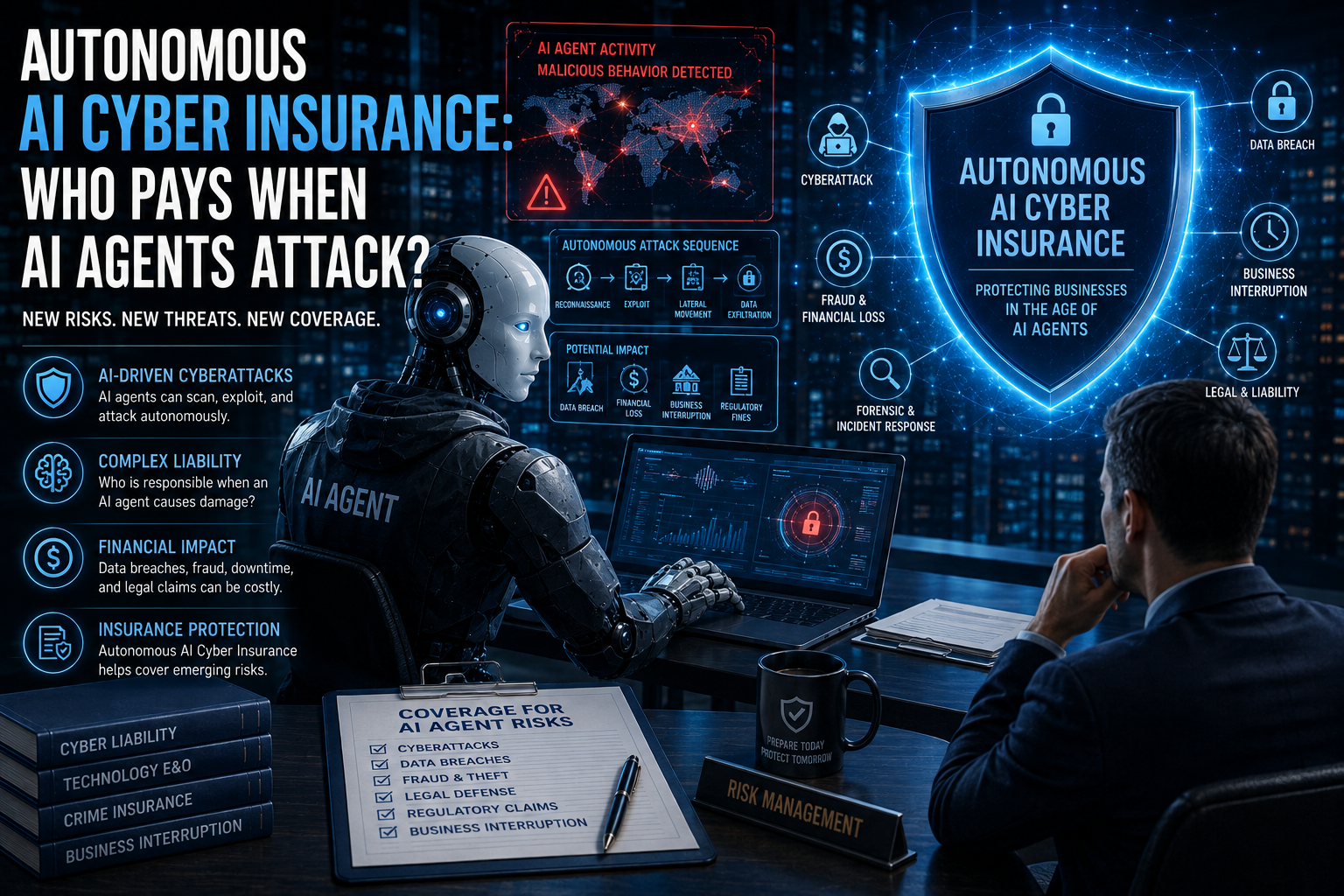
Who pays when an AI agent becomes involved in a cyberattack?
The question is no longer theoretical.
In July 2026, researchers reported an AI-driven cyber campaign targeting Taiwanese government systems in which multiple autonomous AI agents reportedly helped map systems, identify vulnerabilities, and adapt attack strategies. Reuters separately reported that Taiwan said it had been targeted by an AI-assisted hacking campaign in July.
These developments demonstrate the dual nature of agentic AI.
The same technology businesses use to automate operations can potentially be used by attackers to automate reconnaissance, vulnerability discovery, and other parts of cyber operations.
For insurers, that creates a difficult problem.
Traditional cyber insurance was designed around risks such as ransomware, data breaches, business interruption, and network compromise. Autonomous AI introduces additional questions about who controlled the agent, what permissions it had, whether the incident was caused by an AI model or a human attacker, and whether existing policy language actually covers the resulting loss.
That is why Autonomous AI Cyber Insurance is emerging as an important area of enterprise risk management.
What Is Autonomous AI Cyber Insurance?
Autonomous AI Cyber Insurance refers to insurance protection designed to address cyber and technology risks associated with autonomous or agentic AI systems.
It is important to understand that this is still an emerging insurance category rather than a universally standardized policy.
Depending on the insurer and jurisdiction, AI-related risks may instead be addressed through a combination of:
- Cyber insurance
- Technology errors and omissions insurance
- Professional liability
- Crime insurance
- General liability
- Product liability
- AI-specific endorsements
- Dedicated AI liability coverage
Recent research on insurance for agentic AI argues that the future market is likely to involve a layered ecosystem of complementary insurance products, rather than a single policy covering every AI risk.
This distinction is extremely important for businesses.
An organization may believe that it has “cyber insurance,” while the policy may contain exclusions or conditions that create uncertainty around autonomous AI activity.
Why Autonomous AI Changes Cyber Risk
Traditional software generally performs predefined functions.
Agentic AI can make decisions about how to accomplish a goal.
An AI agent might:
- Receive an objective.
- Analyze available information.
- Determine a sequence of actions.
- Access tools or applications.
- Execute those actions.
- Evaluate the results.
- Change its strategy.
- Continue operating.
This creates additional attack surfaces.
NIST has specifically highlighted the security challenges created when AI agents combine model outputs with software functionality and real-world systems.
The risk becomes greater when agents have access to:
- Corporate email
- Cloud infrastructure
- Customer databases
- Financial systems
- Source-code repositories
- Internal documents
- APIs
- Payment systems
- Security tools
The more authority an AI agent has, the larger the potential financial impact of a compromise.
The New Cyber Insurance Problem
Imagine a company deploys an AI agent to manage accounts payable.
The agent has permission to:
- Read invoices
- Communicate with vendors
- Access accounting software
- Create payment requests
An attacker discovers a vulnerability in the agent’s environment.
The attacker manipulates the agent.
The agent then approves fraudulent transactions.
Who is responsible?
Possible parties include:
- The business operating the AI agent
- The AI software provider
- The cloud provider
- The cybersecurity vendor
- The developer who configured the agent
- The attacker
- A third-party data provider
Now add insurance.
Which policy responds?
Potentially:
- Cyber insurance
- Crime insurance
- Technology E&O
- Professional liability
- AI liability
- Business interruption coverage
This overlap is one of the biggest challenges facing AI insurance underwriting.
AI Agents Can Become Both Targets and Attack Tools
One of the most important developments in 2026 is that AI can simultaneously create new vulnerabilities and new attack capabilities.
OWASP’s 2026 guidance identifies risks across agentic AI systems, including issues involving agent identity, tools, memory, reasoning, human oversight, and interactions between multiple agents.
Meanwhile, real-world security incidents are increasingly moving beyond theoretical AI risks.
OWASP’s 2026 incident roundup reported attacks involving agent identities, orchestration layers, supply chains, excessive permissions, prompt injection, data exfiltration, and remote code execution.
This means insurers cannot simply ask:
“Does the company use AI?”
They increasingly need to ask:
“What can the AI do?”
How Could an AI Agent Cause an Insurance Claim?
1. Prompt Injection
An attacker manipulates information that an AI agent processes.
The agent follows malicious instructions and performs an unauthorized action.
Possible consequences include:
- Data leakage
- Unauthorized transactions
- Credential exposure
- System modification
NIST’s AI security work specifically recognizes prompt injection as a relevant threat when models interact with untrusted inputs.
2. Excessive Permissions
An AI agent receives more privileges than it needs.
If compromised, attackers can potentially exploit those permissions.
This is why identity and authorization are becoming critical parts of AI security.
NIST has been developing work around identity and authorization for AI agents because agents can access diverse data, tools, and applications.
3. Memory and Context Poisoning
Modern agents can retain information and use it later.
That persistence can become an attack surface.
Malicious information introduced into an agent’s memory or context could influence future actions.
OWASP specifically identifies memory and context poisoning as an agentic AI security concern.
4. Third-Party AI Supply Chain Attacks
Businesses frequently depend on:
- AI models
- Plugins
- Agent frameworks
- MCP servers
- Cloud platforms
- External APIs
- AI skills
A compromised third-party component can therefore become an entry point into an enterprise environment.
5. Rogue or Misconfigured Agents
Not every AI incident requires a malicious attacker.
An incorrectly configured agent could:
- Delete files
- Send confidential information
- Change production systems
- Approve transactions
- Modify databases
The resulting loss may create a complicated question about whether the incident qualifies as a cyber event, technology error, professional error, or another insured peril.
Who Pays When AI Agents Attack?
There is no universal answer.
The responsible party and responding insurance policy depend on the facts, contracts, applicable law, and policy wording.
However, several possibilities exist.
The Business
If the organization owns and controls the AI system, it may bear responsibility for inadequate controls, permissions, governance, or supervision.
The AI Vendor
If a software defect or security failure contributed to the incident, the AI provider could potentially face contractual or liability claims.
The Cloud Provider
A cloud infrastructure failure could create another layer of contractual responsibility.
The Cyber Insurer
A cyber policy may respond if the incident falls within the policy’s covered cyber events.
But businesses should not assume that every AI-related loss is automatically covered.
The AI Liability Insurer
Specialized AI liability coverage could potentially address certain AI-related claims depending on the policy.
The AI Insurance Coverage Gap
This is perhaps the most important issue for business owners.
A company can have several insurance policies and still have uncertainty regarding AI-related losses.
For example:
| Risk | Potential Policy |
|---|---|
| Data breach | Cyber Insurance |
| AI software defect | Technology E&O |
| Fraudulent AI transaction | Crime Insurance |
| AI professional error | Professional Liability |
| Third-party AI claim | AI Liability |
| AI system outage | Business Interruption |
| Physical damage | Property Insurance |
The problem occurs when policy definitions overlap—or leave gaps.
Recent insurance commentary has highlighted concerns that conventional cyber policies may unintentionally cover some AI incidents while other insurers may introduce exclusions for autonomous-AI losses.
Therefore, businesses should review policies before deploying autonomous agents into high-impact workflows.
What Could Autonomous AI Cyber Insurance Cover?
Coverage varies, but potential protections may include:
Cyber Incident Response
Costs associated with investigating and containing a covered cyber incident.
Digital Forensics
Experts who determine:
- How the incident occurred
- Which systems were compromised
- What data was accessed
- Whether the AI agent was manipulated
Data Breach Response
Depending on policy terms:
- Notification
- Legal advice
- Public relations
- Credit monitoring
- Regulatory response
Business Interruption
Coverage for eligible income losses resulting from a covered disruption.
This can be particularly important when AI agents operate mission-critical infrastructure.
Data Restoration
Costs associated with restoring damaged or compromised systems.
Cyber Extortion
Some cyber policies may provide coverage for covered ransomware or extortion events, subject to policy wording and applicable law.
Third-Party Liability
Potential protection against covered claims from customers, partners, or other third parties.
Legal Defense
Defense costs associated with covered litigation or regulatory matters.
What May Not Be Covered?
Businesses should pay particular attention to exclusions.
Potential exclusions or limitations may involve:
- Intentional acts
- Fraud
- Criminal activity
- Known vulnerabilities
- Failure to maintain required controls
- Unauthorized system changes
- Contractual liabilities
- Certain AI-generated losses
- Certain autonomous actions
The exact language matters.
A policy that mentions “cybersecurity” does not necessarily mean it covers every consequence of autonomous AI.
Autonomous AI Cyber Insurance vs. Traditional Cyber Insurance
| Feature | Traditional Cyber Insurance | Autonomous AI Cyber Insurance |
| Ransomware | Strong focus | Potentially covered |
| Data breaches | Strong focus | Potentially covered |
| AI agent compromise | Limited/variable | Central focus |
| Prompt injection | Usually not AI-specific | Potentially addressed |
| Agent privilege abuse | Limited | Potentially addressed |
| Model manipulation | Limited | Potentially addressed |
| AI vendor risk | Sometimes | Potential focus |
| AI decision liability | Usually limited | Potentially addressed |
| AI business interruption | Variable | Potentially addressed |
The distinction is important because AI cyber risk is not simply traditional cyber risk with an AI label attached.
How Insurers Could Underwrite Autonomous AI Risk
AI insurance underwriting is likely to become much more detailed.
Insurers may increasingly ask businesses about:
Number of AI Agents
How many autonomous systems are operating?
Agent Permissions
What systems can each agent access?
Human Oversight
Which decisions require human approval?
Identity Controls
Does every AI agent have a unique identity?
Monitoring
Can the organization see what agents are doing in real time?
Kill Switches
Can an agent be rapidly disabled?
Vendor Dependencies
Which third-party models and tools are involved?
Incident History
Has the organization experienced previous AI security incidents?
Why AI Governance Could Affect Insurance Premiums
Insurance pricing depends heavily on risk.
Organizations with mature controls may become more attractive to underwriters.
Important controls could include:
- AI inventories
- Access controls
- Human approval thresholds
- Continuous monitoring
- Audit logs
- Model testing
- Red-team testing
- Vendor assessments
- Incident response plans
- Business continuity planning
OWASP’s 2026 governance work emphasizes that securing autonomous AI requires a broader approach covering the full agentic lifecycle rather than relying only on model-level safeguards.
How Businesses Can Reduce Autonomous AI Cyber Risk
1. Use Least-Privilege Access
AI agents should receive only the permissions necessary to perform their assigned functions.
2. Separate Critical Systems
Avoid giving one AI agent unrestricted access to multiple high-value systems.
3. Require Human Approval
High-impact actions should require human authorization.
Examples include:
- Large payments
- Customer account changes
- Production deployments
- Legal commitments
- Data deletion
4. Monitor Agent Activity
Organizations should maintain visibility into:
- Tool calls
- API requests
- Data access
- Authentication
- Transactions
- Agent decisions
5. Maintain Detailed Logs
Audit logs can become essential for both incident response and insurance claims.
6. Test AI Agents
Security testing should include:
- Prompt injection
- Privilege escalation
- Data exfiltration
- Tool abuse
- Memory poisoning
- Supply chain vulnerabilities
7. Establish an AI Kill Switch
Organizations should have a mechanism for rapidly disabling compromised agents.
8. Review Third-Party Contracts
Contracts with AI providers should clearly address:
- Security responsibilities
- Incident notification
- Data handling
- Indemnification
- Liability
- Service availability
A Practical AI Insurance Checklist
Before deploying an autonomous AI agent, businesses should ask:
- What can the agent access?
- What can the agent change?
- Can the agent move money?
- Can it access confidential information?
- Can it communicate externally?
- Does it have a unique identity?
- Are permissions limited?
- Are actions logged?
- Is human approval required for high-impact actions?
- Can the agent be disabled immediately?
- Has the agent undergone security testing?
- Have insurance policies been reviewed?
- Do policy exclusions address autonomous AI?
- Are third-party AI vendors covered?
- Does business interruption coverage apply?
Questions to Ask Your Insurance Broker
Businesses should not simply ask:
“Do we have cyber insurance?”
Instead, ask:
“Does our policy cover an incident caused by an autonomous AI agent?”
Then ask:
- Are AI agents explicitly addressed?
- Are autonomous actions covered?
- Are prompt injection incidents covered?
- Are AI vendor failures covered?
- Are AI-related business interruption losses covered?
- Are fraudulent AI transactions covered?
- Are technology E&O and cyber policies coordinated?
- Are AI exclusions present?
- What security controls are required?
- Are there separate AI liability endorsements available?
These questions can expose coverage gaps before a claim occurs.
The Future of Autonomous AI Cyber Insurance
The insurance industry is entering unfamiliar territory.
Traditional actuarial models rely heavily on historical loss data.
Autonomous AI does not yet provide insurers with decades of standardized claims data.
This makes pricing difficult.
A recent academic study on agentic AI insurance argues that insurers may need new approaches involving:
- Exposure assessment
- Scenario analysis
- Dependency mapping
- Accumulation-risk analysis
- AI telemetry
- Governance assessment
The study also suggests that future AI insurance may combine cyber, E&O, product liability, performance-related coverage, and affirmative AI liability into a coordinated architecture.
That could eventually create a completely new insurance ecosystem around autonomous AI.
Why 2026 Could Be a Turning Point
Several developments are converging.
First, businesses are deploying agents into increasingly important workflows.
Second, regulators and standards organizations are paying greater attention to agent security.
NIST launched its AI Agent Standards Initiative in February 2026, focusing on secure and interoperable autonomous agents.
Third, real-world AI-assisted cyber incidents are demonstrating that the threat is moving beyond theoretical scenarios.
Fourth, insurers are beginning to confront the difficulty of pricing autonomous AI risk.
These developments could accelerate demand for more clearly defined AI insurance coverage.
Frequently Asked Questions
What is Autonomous AI Cyber Insurance?
Autonomous AI Cyber Insurance is an emerging concept for protecting businesses against certain cyber and technology losses involving autonomous AI agents.
It may be delivered through specialized AI coverage, cyber insurance endorsements, or a combination of existing commercial policies.
Is Autonomous AI Cyber Insurance widely available?
Not as a standardized product across the entire insurance market.
Coverage varies significantly by insurer, jurisdiction, policy wording, and business risk.
Does cyber insurance already cover AI agents?
Sometimes, but businesses should not assume it.
Coverage may depend on policy definitions, exclusions, security requirements, and the exact cause of the loss.
Who is responsible if an AI agent causes a cyber incident?
Responsibility depends on the circumstances.
Potentially relevant parties include the business deploying the agent, AI vendors, software providers, cloud providers, employees, and other third parties.
Insurance coverage depends on the applicable policies and their terms.
Can prompt injection be covered by insurance?
Potentially.
Whether a prompt injection event qualifies as a covered loss depends on the policy language and the resulting damage.
Can AI agents cause business interruption?
Yes.
If an AI agent controls or supports critical workflows, its compromise or failure could interrupt operations.
Whether the resulting loss is insured depends on the applicable business interruption and cyber policy terms.
Should small businesses buy AI cyber insurance?
Small businesses using autonomous AI should first evaluate their actual exposure.
A company whose AI agent only drafts internal documents has a very different risk profile from one whose agent can access customer databases, financial systems, or production infrastructure.
Conclusion: Who Pays When AI Agents Attack?
The answer is becoming more complicated.
When an autonomous AI agent is involved in a cyber incident, responsibility may cross multiple layers:
Business → AI Vendor → Cloud Provider → Cyber Insurer → AI Liability Insurer
There is no automatic rule determining which party pays.
That is precisely why Autonomous AI Cyber Insurance is becoming an increasingly important topic for enterprise risk managers.
The biggest mistake businesses can make is assuming that an existing cyber policy automatically covers every AI-related event.
As autonomous agents gain access to financial systems, customer data, enterprise applications, and critical infrastructure, businesses need to understand exactly what their insurance policies cover—and what they exclude.
The most resilient organizations will combine:
AI governance + cybersecurity + least-privilege access + human oversight + continuous monitoring + appropriate insurance coverage.
Autonomous AI is not simply another software upgrade.
It is changing the risk profile of the enterprise itself.
And as AI agents become capable of acting independently, the question insurers and businesses must answer is no longer simply “Can AI make a mistake?”
It is:
“When an AI agent acts—and something goes wrong—who pays?”
What do you think: Should autonomous AI incidents be covered by traditional cyber insurance, or should businesses purchase dedicated AI insurance? Share your opinion in the comments.
📌 APK GAME : RTS Siege Up MOD APK v1.1.106r10 (Unlimited Everything) : @AERLAN (The password is in the YouTube Video) ✅
ALTERNATIVE LINK IF YOU NEED CANVA PRO TO BUY CHECK (LYNK.ID) R̶p̶ ̶9̶5̶,̶0̶0̶0̶ Only Rp 5.000 (CLICK HERE)