Daftar isi: [Hide]
- 1Introduction
- 2AI Hallucinations.
- 3Limited Training Data
- 4Ambiguous Prompts
- 5Outdated Knowledge
- 6Missing Context
- 7Complex Reasoning Tasks
- 8Financial Institutions
- 9Healthcare
- 10Legal Services
- 11Insurance Companies
- 12Technology Companies
- 13Legal Defense Costs
- 14Third-Party Liability
- 15Regulatory Investigations
- 16Professional Liability
- 17Crisis Management
- 18Business Interruption
- 19Scenario 1: AI Creates a Fake Legal Citation
- 20Scenario 2: AI Recommends Incorrect Financial Advice
- 21Scenario 3: AI Generates Incorrect Medical Information
- 22Scenario 4: AI Produces Defamatory Content
- 22.1Banking
- 22.2Healthcare
- 22.3Legal Services
- 22.4Insurance
- 22.5Technology
- 22.6Retail
- 23AI Governance
- 24Human Review
- 25Industry
- 26AI Dependency
- 27Incident History
- 28Cybersecurity
- 29Maintaining Human Oversight
- 30Validating AI Outputs
- 31Improving Prompt Design
- 32Monitoring AI Performance
- 33Training Employees
- 34Implementing AI Governance
- 35What is an AI hallucination?
- 36Is AI Hallucination Insurance available today?
- 37Which businesses should consider this coverage?
- 38Can hallucinations cause legal liability?
- 39How can businesses reduce hallucination risks?
- 40📌 The password is in the YouTube video : @AERLAN (LINK RESMI PART 1) JOIN NOW ✅

Introduction
Artificial Intelligence is rapidly becoming the decision-making engine behind modern businesses. From customer support and legal research to financial forecasting and software development, AI systems are helping organizations improve productivity while reducing operational costs.
However, alongside these benefits comes a growing and often underestimated challenge:
AI Hallucinations.
Unlike ordinary software bugs, AI hallucinations occur when an artificial intelligence model confidently generates information that is false, misleading, fabricated, or unsupported by factual evidence.
These outputs may appear completely convincing—even to experienced professionals.
For businesses, the consequences can be severe:
- Incorrect legal advice
- Financial losses
- Compliance violations
- Intellectual property disputes
- Customer lawsuits
- Reputation damage
- Operational disruption
As enterprises integrate generative AI into critical business processes, insurers are beginning to evaluate an entirely new category of commercial risk.
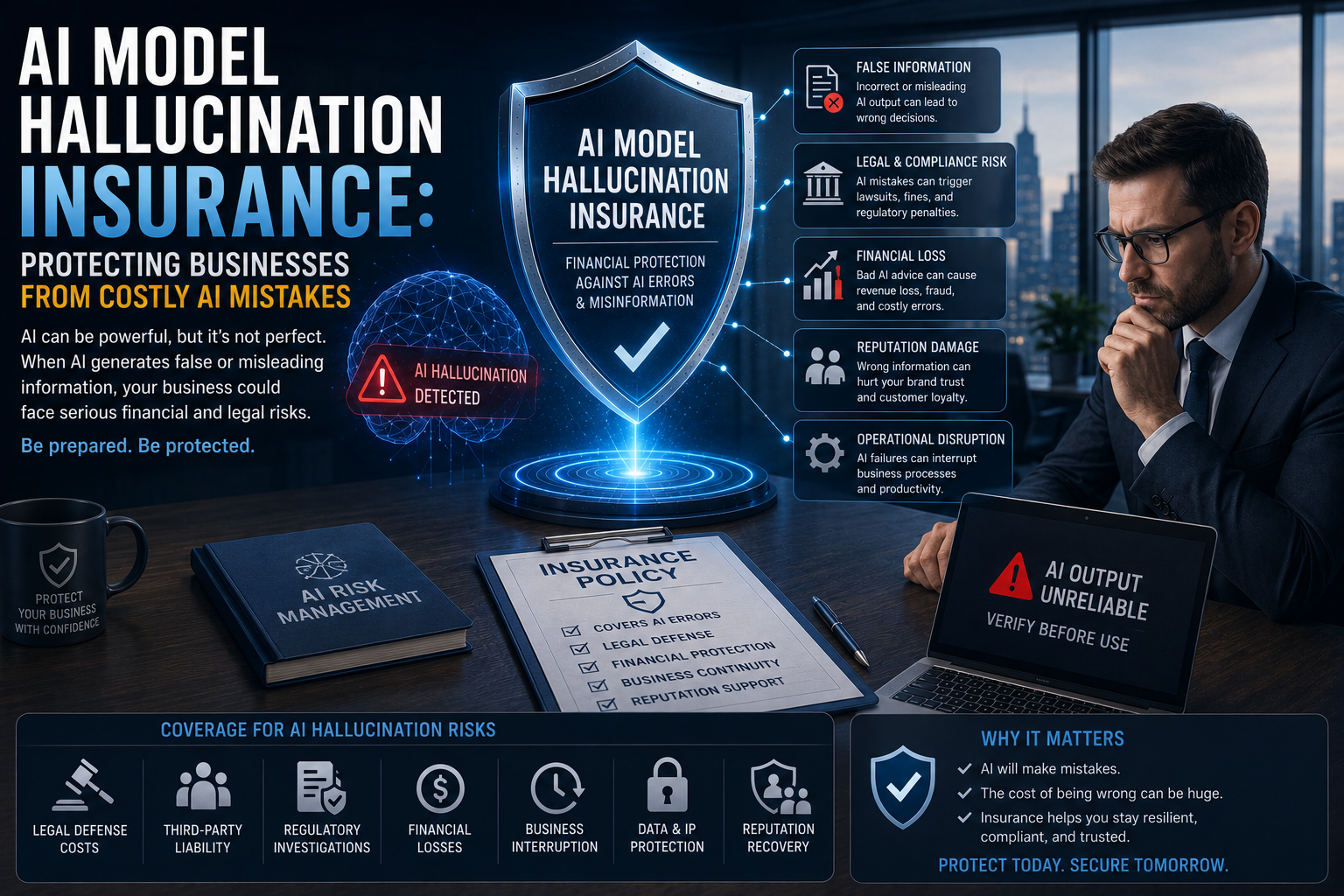
This emerging market is known as AI Model Hallucination Insurance.
What Is an AI Hallucination?
An AI hallucination occurs when an artificial intelligence model generates content that is inaccurate but presented with high confidence.
Hallucinations may involve:
- Invented facts
- Fabricated references
- Incorrect calculations
- Nonexistent legal cases
- False medical information
- Imaginary product specifications
- Incorrect financial recommendations
The challenge is that these responses often sound credible, making them difficult to detect without human verification.
Why Hallucinations Happen
Large language models generate responses by predicting likely sequences of text rather than verifying every statement against reality.
Hallucinations can result from:
Limited Training Data
The model may lack sufficient information about a specific topic.
Ambiguous Prompts
Poorly defined questions can encourage speculative responses.
Outdated Knowledge
Models may rely on information that no longer reflects current facts.
Missing Context
Without relevant business context, AI may fill gaps with plausible—but incorrect—information.
Complex Reasoning Tasks
Lengthy calculations, legal analysis, or technical questions can increase the likelihood of errors.
Why AI Hallucinations Matter for Businesses
For enterprise organizations, a single inaccurate AI response can trigger substantial financial consequences.
Examples include:
Financial Institutions
Incorrect lending recommendations.
Faulty fraud alerts.
Investment mistakes.
Healthcare
Inaccurate diagnostic suggestions.
Medication errors.
Patient safety concerns.
Legal Services
Fabricated case citations.
Incorrect legal analysis.
Contract interpretation mistakes.
Insurance Companies
Improper claim decisions.
Incorrect underwriting recommendations.
Risk misclassification.
Technology Companies
Defective AI-powered software.
Incorrect API responses.
Faulty customer support.
The Financial Cost of AI Hallucinations
Hallucinations can affect nearly every aspect of business operations.
Potential consequences include:
| Business Impact | Estimated Cost |
|---|---|
| Customer Lawsuits | $100,000 – $50 Million+ |
| Regulatory Investigations | $50,000 – $10 Million |
| Business Interruption | $25,000 – Millions |
| Brand Reputation Damage | Difficult to quantify |
| Contract Disputes | $50,000 – Millions |
| Intellectual Property Claims | $100,000 – Millions |
For organizations operating at enterprise scale, even one major incident may generate substantial costs.
What Is AI Model Hallucination Insurance?
AI Model Hallucination Insurance is a specialized insurance product designed to help organizations manage financial losses associated with inaccurate AI-generated outputs.
While products continue to evolve, insurers are increasingly evaluating ways to address risks related to generative AI and automated decision-making.
Coverage may be offered through specialized endorsements or broader technology liability policies, depending on the insurer.
What Could Be Covered?
Although policy wording differs among insurers, coverage may include:
Legal Defense Costs
Attorney fees.
Expert witnesses.
Court expenses.
Settlement negotiations.
Third-Party Liability
Protection against claims alleging financial harm caused by inaccurate AI outputs.
Regulatory Investigations
Coverage may assist with legal defense during government inquiries related to AI governance or compliance.
Professional Liability
Protection when AI-assisted professional services contribute to client losses.
Crisis Management
Public relations support.
Customer notification.
Reputation recovery.
Business Interruption
Financial assistance following covered AI operational failures that interrupt normal business activities.
What May Not Be Covered?
Businesses should carefully review exclusions.
Common examples include:
- Intentional misconduct
- Fraud committed by the insured
- Known defects before coverage begins
- Criminal activity
- Failure to maintain required security controls
- Contractual guarantees
- Ordinary software maintenance
Policy terms vary significantly among insurers.
Real-World Business Scenarios
Scenario 1: AI Creates a Fake Legal Citation
A law firm relies on generative AI to prepare a legal brief.
The system invents court cases that do not exist.
The filing is rejected, resulting in legal costs and reputational damage.
Scenario 2: AI Recommends Incorrect Financial Advice
An investment platform delivers inaccurate AI-generated recommendations.
Customers experience losses and initiate legal action.
Scenario 3: AI Generates Incorrect Medical Information
A healthcare application produces misleading clinical guidance.
The organization faces regulatory scrutiny and liability claims.
Scenario 4: AI Produces Defamatory Content
An enterprise marketing platform generates false statements about another company.
Potential consequences include defamation claims and reputational harm.
Industries Most at Risk
Organizations with extensive AI adoption face higher exposure.
Examples include:
Banking
AI-powered lending, fraud detection, and financial analysis.
Healthcare
Clinical decision support and medical documentation.
Legal Services
Contract analysis and legal research.
Insurance
Automated underwriting and claims processing.
Technology
Generative AI products and SaaS platforms.
Retail
Customer service chatbots and recommendation engines.
AI Hallucination Insurance vs. AI Liability Insurance
| Feature | AI Hallucination Insurance | AI Liability Insurance |
|---|---|---|
| False AI outputs | Yes | Often |
| AI decision errors | Yes | Yes |
| Professional negligence | Sometimes | Yes |
| Intellectual property claims | Often | Often |
| Business interruption | Sometimes | Limited |
| Regulatory investigations | Often | Often |
In practice, hallucination-related risks may be addressed through broader AI liability policies rather than a standalone product, depending on the insurer and jurisdiction.
How Insurers Evaluate Risk
Underwriters typically consider:
AI Governance
Does the company have documented oversight?
Human Review
Are important AI outputs reviewed before use?
Industry
Highly regulated sectors often face greater scrutiny.
AI Dependency
How essential is AI to daily operations?
Incident History
Past AI-related claims or failures may influence premiums.
Cybersecurity
Strong security controls reduce overall operational risk.
Best Practices for Businesses
Organizations can reduce hallucination risk by:
Maintaining Human Oversight
Never allow critical decisions to rely solely on AI-generated content.
Validating AI Outputs
Fact-check important responses before publication or implementation.
Improving Prompt Design
Clear prompts reduce ambiguity and improve reliability.
Monitoring AI Performance
Continuously measure accuracy and investigate anomalies.
Training Employees
Staff should understand AI limitations and escalation procedures.
Implementing AI Governance
Formal governance programs help ensure responsible deployment and oversight.
Questions to Ask Before Purchasing Coverage
Before buying an AI-related policy, ask:
- Does the policy specifically address AI-generated errors?
- Are generative AI systems included?
- Is coverage available for third-party AI vendors?
- Are legal defense costs covered?
- Does the policy include regulatory investigations?
- Are business interruption losses eligible?
- What exclusions apply to AI hallucinations?
- Are international operations covered?
These questions can help clarify how the policy responds to AI-specific risks.
Future Trends
The market for AI-related insurance is expected to evolve rapidly.
Potential developments include:
- Dedicated AI hallucination endorsements
- AI accuracy scoring during underwriting
- Real-time monitoring of AI risk exposure
- Premium discounts for certified AI governance
- Integration with enterprise AI management systems
As AI becomes more deeply embedded in business operations, insurers are likely to refine products to address emerging risks more precisely.
Frequently Asked Questions
What is an AI hallucination?
An AI hallucination occurs when an artificial intelligence system produces information that is inaccurate or fabricated while presenting it confidently.
Is AI Hallucination Insurance available today?
Some insurers are beginning to address these risks through technology liability, professional liability, or specialized AI endorsements. Availability varies by insurer and market.
Which businesses should consider this coverage?
Organizations that rely heavily on generative AI or automated decision-making—particularly in regulated industries—should evaluate whether specialized AI-related coverage is appropriate.
Can hallucinations cause legal liability?
Yes. If inaccurate AI-generated information causes financial harm, legal disputes may arise depending on the circumstances and applicable laws.
How can businesses reduce hallucination risks?
Combining human oversight, robust AI governance, employee training, output validation, and strong cybersecurity practices can significantly reduce exposure.
Outbound Links
- NIST AI Risk Management Framework
- ISO/IEC 42001 AI Management Systems
- OWASP Top 10 for Large Language Model Applications
Conclusion
Artificial intelligence is transforming industries by improving efficiency, accelerating innovation, and supporting more informed decision-making. Yet the same technology can also generate convincing—but incorrect—information that creates legal, financial, and operational risks.
AI Model Hallucination Insurance represents an emerging area of enterprise risk management aimed at addressing these challenges. While products continue to develop, organizations should not rely on insurance alone. Strong governance, careful human review, effective risk controls, and ongoing monitoring remain essential for using AI responsibly.
Businesses that proactively manage hallucination risk today will be better prepared to harness the benefits of AI while reducing the likelihood of costly mistakes tomorrow.
Has your organization established safeguards to detect and manage AI hallucinations? Share your experiences or questions in the comments below.
📌 The password is in the YouTube video : @AERLAN (LINK RESMI PART 1) JOIN NOW ✅
ALTERNATIVE LINK IF YOU NEED TO BUY CHECK (LYNK.ID) R̶p̶ ̶9̶5̶,̶0̶0̶0̶ Only Rp 5.000 (CLICK HERE)
̶
OR YOU CAN CHECK VIA SHOPEE (CLICK HERE) If you want to know if there are any new updates, please join the group. (CLICK HERE)