Daftar isi: [Hide]
- 1A New AI Threat Is Costing Businesses Millions
- 2AI Tools Have Become Cheap and Accessible
- 3Deepfake Attacks Are More Convincing
- 4Businesses Depend on Digital Communication
- 5Financial Services
- 6Healthcare
- 7Technology Companies
- 8Professional Services
- 9Manufacturing
- 10E-Commerce
- 10.6Employee Training
- 10.7Verification Procedures
- 10.8Multi-Factor Authentication
- 10.9Vendor Controls
- 10.10AI Governance
- 11Verify High-Risk Transactions
- 12Train Employees
- 13Implement Multi-Factor Authentication
- 14Use AI Detection Tools
- 15Maintain Incident Response Plans
- 16What is deepfake fraud insurance?
- 17Does cyber insurance cover deepfake attacks?
- 18Who needs deepfake fraud insurance?
- 19How common are deepfake attacks?
- 20Is deepfake fraud expected to increase?
- 21📌 The password is in the YouTube video : @AERLAN (LINK RESMI PART 1) JOIN NOW ✅

A New AI Threat Is Costing Businesses Millions
Artificial intelligence has transformed business operations, but it has also created a new generation of cybercrime.
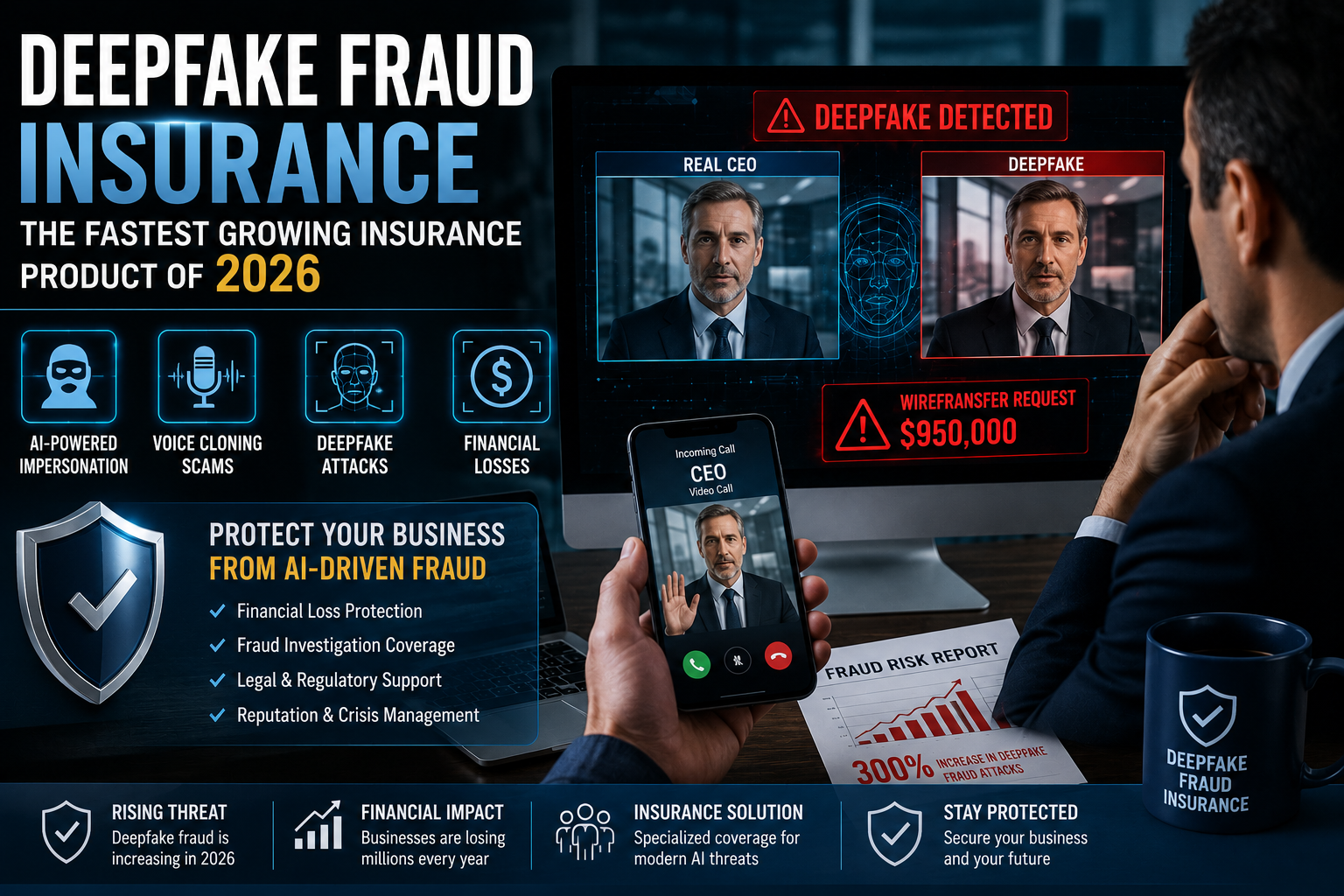
In 2026, one of the fastest-growing threats facing organizations is deepfake fraud. Criminals can now generate realistic voices, videos, images, and identities that convincingly impersonate executives, employees, vendors, or customers. These attacks are becoming increasingly sophisticated and difficult to detect. Experts across the insurance and fraud-prevention industries warn that deepfake-enabled fraud is rapidly emerging as a major business risk.
As losses continue to rise, insurers are responding with a new category of protection:
Deepfake Fraud Insurance.
Many analysts now consider this one of the fastest-growing commercial insurance segments of 2026.
What Is Deepfake Fraud?
Deepfake fraud occurs when cybercriminals use artificial intelligence to impersonate real people through:
- Synthetic voice cloning
- AI-generated videos
- Fake executive communications
- Forged identity documents
- Manipulated photographs
- Artificial customer identities
The goal is usually financial gain.
Fraudsters may convince employees to:
- Transfer funds
- Change banking information
- Approve invoices
- Reveal sensitive information
- Grant system access
Modern deepfakes can appear so realistic that traditional verification methods often fail.
Why Deepfake Fraud Is Exploding in 2026
Several factors are driving unprecedented growth.
AI Tools Have Become Cheap and Accessible
Creating convincing fake content once required advanced technical expertise.
Today, many AI tools can generate realistic voices, videos, and images in minutes.
The barrier to entry has collapsed, allowing criminals to scale operations globally.
Deepfake Attacks Are More Convincing
Voice cloning technology can imitate executives with remarkable accuracy.
A simple phone call that appears to come from a CEO may actually be generated by AI.
Video-based impersonation attacks are becoming increasingly common as well.
Businesses Depend on Digital Communication
Remote work and global collaboration mean employees frequently approve transactions without meeting face-to-face.
This creates ideal conditions for AI-powered impersonation schemes.
Real Examples of Deepfake Fraud
The threat is no longer theoretical.
Industry reports show that AI-generated fraud attempts have surged dramatically in recent years. Some studies estimate deepfake-related fraud activity has increased by more than 2,000% over the last three years.
Insurance companies are already seeing significant impacts.
Recent fraud investigations uncovered record levels of fraudulent claims supported by AI-generated evidence, altered documents, and fabricated imagery.
Fraud experts increasingly describe deepfake-enabled deception as one of the most significant operational risks facing organizations today.
What Is Deepfake Fraud Insurance?
Deepfake Fraud Insurance is designed to protect businesses from financial losses caused by AI-generated impersonation attacks.
Depending on policy language, coverage may include:
Financial Losses
Protection against:
- Fraudulent wire transfers
- Social engineering scams
- Executive impersonation fraud
- Payment diversion schemes
Investigation Costs
Coverage for:
- Digital forensics
- Incident investigations
- Fraud analysis
- Recovery services
Legal Expenses
Protection against:
- Lawsuits
- Regulatory actions
- Contract disputes
Crisis Management
Support for:
- Public relations services
- Reputation recovery
- Customer communication
Business Interruption
Coverage for revenue losses caused by operational disruption after a fraud incident.
Why Traditional Insurance May Not Cover Deepfake Attacks
Many business owners assume existing policies provide adequate protection.
Unfortunately, that assumption can be dangerous.
Several insurers have discovered that traditional cyber insurance and crime insurance policies often contain coverage gaps when AI-generated impersonation is involved. Coverage outcomes may depend heavily on policy wording and whether social engineering endorsements are included.
This has created growing demand for specialized deepfake coverage.
Businesses are increasingly reviewing policies to ensure AI-related fraud risks are addressed explicitly.
Industries Most Vulnerable to Deepfake Fraud
Financial Services
Banks and financial institutions handle large transactions daily.
Fraudsters frequently target payment authorization processes.
Healthcare
Healthcare providers store sensitive patient information and process large volumes of claims.
Technology Companies
Technology firms often operate remotely and rely heavily on digital communications.
Professional Services
Law firms, consultants, and accounting firms manage confidential client information.
Manufacturing
Global supply chains create opportunities for invoice fraud and vendor impersonation.
E-Commerce
Online businesses process payments continuously and face growing identity verification challenges.
The Connection Between Deepfake Fraud and Cyber Insurance
Many businesses ask:
Is cyber insurance enough?
The answer depends on the policy.
Some cyber insurance products provide partial protection against AI-enabled fraud.
Others exclude certain forms of social engineering attacks.
As a result, insurers are increasingly developing dedicated endorsements and standalone products focused specifically on deepfake risks.
This trend mirrors the early development of cyber insurance itself.
How Insurers Evaluate Deepfake Risk
Insurance providers increasingly assess:
Employee Training
Can employees identify suspicious communications?
Verification Procedures
Are payment approvals independently verified?
Multi-Factor Authentication
Strong authentication significantly reduces fraud exposure.
Vendor Controls
How are vendor payment changes validated?
AI Governance
Does the company have policies governing AI usage and security?
Organizations with stronger controls often qualify for better coverage terms and lower premiums.
Deepfake Fraud Insurance Costs in 2026
Pricing varies based on:
- Industry
- Revenue
- Transaction volume
- Cybersecurity maturity
- Claims history
- Coverage limits
Typical annual premiums may range from:
| Business Size | Estimated Annual Premium |
|---|---|
| Small Business | $500 – $3,000 |
| Mid-Sized Company | $3,000 – $20,000 |
| Enterprise Organization | $20,000+ |
For many organizations, these costs are modest compared to potential fraud losses that can reach hundreds of thousands or even millions of dollars.
Deepfake Fraud Prevention Best Practices
Insurance is important, but prevention remains essential.
Verify High-Risk Transactions
Require secondary verification for:
- Wire transfers
- Banking changes
- Vendor updates
Train Employees
Regular awareness training helps employees recognize AI-powered scams.
Implement Multi-Factor Authentication
MFA significantly reduces account compromise risks.
Use AI Detection Tools
Organizations increasingly deploy deepfake detection technologies to identify synthetic media.
Maintain Incident Response Plans
Preparation can dramatically reduce losses when attacks occur.
Fraud-prevention communities increasingly emphasize layered defenses rather than relying on a single verification method.
The Future of Deepfake Insurance
Industry experts expect deepfake-related fraud to continue growing throughout 2026 and beyond.
Emerging trends include:
- Deepfake-specific insurance endorsements
- AI impersonation coverage
- Enhanced social engineering protection
- Real-time fraud monitoring integration
- AI-powered underwriting
- Behavioral risk scoring
Researchers studying AI insurance markets note that insurers are actively redefining coverage boundaries as AI-related threats evolve.
As businesses become increasingly dependent on digital communications, demand for deepfake fraud protection is expected to accelerate.
Frequently Asked Questions
What is deepfake fraud insurance?
Deepfake fraud insurance protects businesses from losses caused by AI-generated impersonation attacks, voice cloning, synthetic media, and related fraud schemes.
Does cyber insurance cover deepfake attacks?
Some policies may provide limited coverage, but many organizations require additional endorsements or specialized coverage.
Who needs deepfake fraud insurance?
Any organization that processes payments, manages sensitive information, or relies heavily on digital communication.
How common are deepfake attacks?
Industry reports indicate rapid growth in deepfake-related fraud and identity impersonation across multiple sectors.
Is deepfake fraud expected to increase?
Yes. Fraud analysts consistently identify deepfake-enabled scams as a major threat category for 2026 and beyond.
Conclusion
Deepfake fraud represents one of the most significant emerging business risks of the AI era.
As voice cloning, synthetic video, and AI-generated identities become more sophisticated, traditional fraud prevention methods are struggling to keep pace. Organizations across every industry face growing exposure to financial loss, reputational damage, and operational disruption.
This reality is driving explosive growth in Deepfake Fraud Insurance, making it one of the most important commercial insurance products of 2026.
Businesses that combine strong cybersecurity controls, employee training, verification procedures, and specialized insurance coverage will be far better positioned to navigate the rapidly evolving AI threat landscape.
Has your business reviewed its insurance coverage for deepfake fraud risks? Share your thoughts and experiences in the comments below.
📌 The password is in the YouTube video : @AERLAN (LINK RESMI PART 1) JOIN NOW ✅
ALTERNATIVE LINK IF YOU NEED TO BUY CHECK (LYNK.ID) R̶p̶ ̶9̶5̶,̶0̶0̶0̶ Only Rp 5.000 (CLICK HERE)
̶
OR YOU CAN CHECK VIA SHOPEE (CLICK HERE)